


They are made of the thing they are running from.
Every Fiat Runner is built from dead currency. Dollar bills, cut apart and reassembled into a body, twenty pieces to a figure, then set on fire and told to run. That is the whole idea in one image. The money is the character, the character is the victim, and the flames behind him are the system he refuses to burn in.
This is Fiat Runners. It is the biggest animated project I have ever built, and it is not finished. I am showing it now because I would rather let you watch it take shape than reveal it polished and pretend it arrived that way.
What it is
Fiat Runners is a collection of 1,971 fully animated pieces. Not stills. Not looping video files sitting on a server. Each one is assembled from as many as forty layered animated vectors on a single square canvas, and every layer moves on its own. Nothing here is a flat picture of motion. It is motion, built one layer at a time.
The number is not random. On August 15, 1971, Richard Nixon went on television and closed the gold window, cutting the last thread between the dollar and gold. That night the money became pure faith. Everything I make argues with that decision. 1,971 runners, one for the year they set the money loose. Bank Runners was 1,776, the year a people declared independence. Fiat Runners is 1,971, the year a currency lost its anchor. The two numbers are the whole story. What we won, and what we let them take back.
Anatomy of a runner


Look at one runner and you are looking at a corpse that learned to sprint. His body is real banknote artwork, cut into exactly twenty parts and rebuilt limb by limb: head, neck, torso, hips, and a full left and right side of shoulders, upper arms, forearms, hands, upper legs, lower legs, ankles, and feet. Five denominations feed the parts bin: the $1, the $5, the $10, the $20, and the $100. One hundred hand-cut body parts total, and every single one animates on its own running cycle.
Here they are, isolated for the first time. Twenty parts per bill, cycling. Watch what they are actually cut from: Washington's face becomes the $1 head. The Great Seal's eagle becomes a torso. "IN GOD WE TRUST" rides across the hips. A serial number runs down a shin like a bone marking. The hands are the most surgical cuts in the whole collection, five fingers scissored out of a bill's engraved border. This is what "made of money" means when you take it literally.


And here is the detail I love most, verified straight against the collection's master data: not one runner in the entire set is built from a single bill. Zero, out of every composition rolled. 94% of the population carries all five denominations at once, Washington's jaw on Franklin's brow with "THE UNITED STATES" stamped down a Hamilton shin. The other 6% are the quiet rares, runners missing one president entirely: a few dozen with no Washington anywhere on the body, a few dozen with no Franklin, a handful missing the $5 or the $10 altogether. Even the most concentrated runner in the set only gets eleven of his twenty parts from one bill. Frankenstein bodies of mixed money, because that is what fiat is: denominations of the same broken promise stitched into something that has to keep moving to stay upright.
Flame trails stream off the front and the back of every figure as he runs, and each trail is its own animated layer. That fire is not decoration. It is the system he is made of, burning in real time. Some run left, some run right. All of them are leaving the frame as fast as the animation will carry them. The money is fleeing the thing the money became.
The attached elements

This is the full figure, assembled and alive: twenty Franklin parts running his cycle with both flame layers burning. The flames are the collection's heartbeat. A front trail and a back trail, each hand-animated, licking off the body at full sprint so every runner reads as a man escaping his own ignition. When you see a Fiat Runner at thumbnail size on a wall of art, the fire is what you recognize first.
But some runners don't run free. A small fraction of the population, fewer than one in eleven, carries something. These are the attached elements, and each one is a way the system keeps its grip on you even while you flee.


The debt ball and chain, shackled to the ankle and dragged at full sprint, is the mortgage, the student loan, the compound interest that runs exactly as fast as you do. The flies are the fees. Not one big predator, a cloud of small ones: overdraft, maintenance, transaction, late. You can outrun a wolf. You cannot outrun a swarm.


The devil cupid hovers at the shoulder whispering buy now, pay later, love on credit, an arrow dipped in APR. And the dogbot trots alongside like man's best friend, except it was built by the repo company and it never gets tired and it never loses your scent. Debt ball, flies, cupid, dogbot: four burdens, distributed thin across the set, so when a collector's runner carries one it actually means something.
If hunting for burdens like these is your kind of collecting, the list at the bottom of this page sees every preview first.
The world he is fleeing
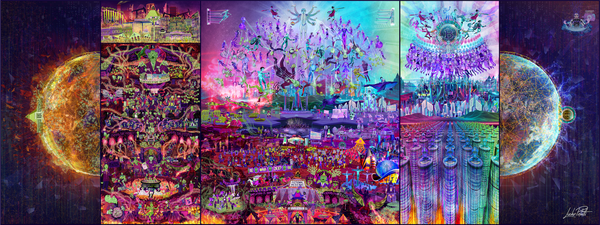
Behind every runner is a full landscape, and every piece rolls its own version of it from a library of hand-built, separately animated layers. This is the propaganda I have been painting for years, finally set in motion. Here is what lives back there, and why.
The false lights


Two masked bodies hang over the scene. A sun and a moon, each wearing the face, the cypherpunk mask that runs through all my work. They are the light that does not lie. Proof of work rising and setting on schedule, indifferent to policy. About two thirds of the population runs under one of these honest lights.


And then the false suns. A Dogecoin planet and a Moonero moon, the joke coins and the copies, glowing just bright enough to pull your eye off the exit. The other third of the collection runs under these. The distractions are not an accident in this world. They are part of the trap. Ten thousand tokens promising the moon so you never notice the one door that actually opens.
The temples


The institutions the runners are leaving stand across the horizon like a skyline of debt. The Federal Reserve, the temple of the printer, a dollar sign flying where a flag should be. The Treasury beside it, the desk where the debt is written.


The Capitol, the room where the spending is voted and the bill is never read. The pyramid lifted straight off the back of the one dollar bill, the all seeing eye blazing over "MDCCLXXVI," a nation that carved an occult symbol of control onto its own money and asked you to trust it. And the answer to all of it, Satoshi Rushmore, the mountain recut so the masked builders of a freer money look back at the monuments of the old one. One set of faces was chiseled by a state. The other showed up anonymous and gave the code away.
The surveillance sky


The sky is busy watching you. A balloon drifts past reading "TRU$T U$," surveillance wearing a smile and a dollar sign. Planes streak the clouds, vultures circle, drones scan. The whole ceiling of this world is a reminder that a system that has to print also has to watch. Sound money needs no permission and keeps no list. Fiat needs both.
The ground
Under their feet, the road itself takes four forms, and each one is an argument. A yellow brick road, because they sold you an emerald city. A masonic checkered path, the lodge floor laid flat under the whole economy. A rugged dirt path, the honest one. And a glowing cyber grid, the road that watches you walk it. The runners cross four worlds too, split evenly through the set: the BTC mountain rising against the dollar, oil rigs pumping the petrodollar's blood, camels crossing a desert of sand-colored money, and a dollar iceberg, the part of the collapse you can see floating over the part you can't.
The horizon

Out at the edge sits the one line that matters. Bitcoin measured against the dollar, rising like a mountain the fiat ship keeps sailing toward and calling a bubble. Every cycle the peak is higher. Every cycle they are surprised.
The creatures
This dystopia has a food chain, and every animal in it is an economic actor. Eight of them, each hand-drawn, each with a job.


The honey badger, chasing a little orange coin across the wasteland, because Bitcoin is the honey badger of money: it does not care. It takes the next block whether you believe in it or not. The horseman is death riding under a dollar-sign banner, the apocalypse this collapse always summons, except his flag is the thing that caused it.


The raptor, branded with a dollar sign, is the fast predator: the flash crash, the margin call, the thing that takes your leg off before you hear it. The sniper bear is my favorite creature in the whole set, a bear in a ghillie suit wearing the skull mask, scoped in and patient. The bear market does not chase you. It waits for you to feel safe.


The vultures circle high over the whole economy, the distressed-asset feeders who eat what the crash leaves. The bats come out because it is always dusk somewhere in a fiat system, the nocturnal money that only moves when nobody is watching.


The whales breach the sky in Bitcoin orange with the ₿ on their flanks, the only creatures in the scene swimming toward the exit, enormous and unbothered. And the frogs arrive in a plague swarm, straight out of Exodus, because when a currency dies the plagues always come in order. This is a dystopia rendered in my own language, and the point of filling it with life is simple. Collapse is not quiet. It is a carnival. The runners are the only ones with the sense to leave.
The pursuers
Then there are the traits you will have to hunt for, because the master data is stingy with them. Fewer than one runner in fifteen is chased from the air, and the pursuers are a bestiary of everything this system sends after you.


The helicopter, because Bernanke promised you the money would come from one, and it did, and this is what it bought. The UFO cows, wealth abducted upward while everyone films it and nobody stops it. The falling nuke, the endgame every unbacked currency war reaches eventually. A bull strapped to a rocket, euphoria with no landing gear. The surveillance drone with its dollar eye. And the mothership, so rare it hangs over almost nothing in the entire population — if your runner flees under the mothership, you own one of the strangest skies in the set.
And in front of the frame, the plagues: floodwater, a fat mosquito with a needle nose built for draining, piranhas with open mouths, frogs out of Exodus, and an inflation sign planted like a road marker. If it sounds biblical, that is because currency collapse always is.
Why runners, again
If you have followed the work, you know Bank Runners. 1,776 digital banknotes, a number that is not an accident, launched in February 2025 and collected by roughly three hundred holders who understood that a run on the banks is not panic, it is clarity. Those receipts are public. Fiat Runners is where that idea grows legs.
Bank Runners was about the moment people wake up. Fiat Runners is about the sprint that comes next. The fiat system is not a background you stand in front of. It is a thing you get out of. Central banks meddle, the money prints, your savings quietly dissolve, and at some point the honest move is to stop negotiating with it and go. That is what these figures are doing. They are not asking the Fed for better terms. They are running.
And they are running toward something. Every critique in my work points the same direction. Fiat is the illusion they are made of. Bitcoin is the exit they are sprinting for. Better money, better world. The runners just make the urgency literal.
Where it stands right now
Honest status, because I do not like fake announcements.
The full set of 1,971 renders exists and animates. I can sit and watch the whole population run, and I have been fixing the collection piece by piece, tightening the run cycles, correcting layers, balancing the rarities. There is real work left. Where it finally lives, and how you will be able to own one, I have not decided. I will make that call when the collection earns it, not before, and not because a calendar told me to.
So this is a preview, in the truest sense of the word. The runners are on the site now, crossing the screen. If you want to see more as it comes together, the fastest way in is the list.
See the runners
They are running across the homepage as you read this. Watch them for a second before you scroll.
If you want first access to Fiat Runners when it is ready, and the previews before anyone else, join the list below. No noise, just the work.
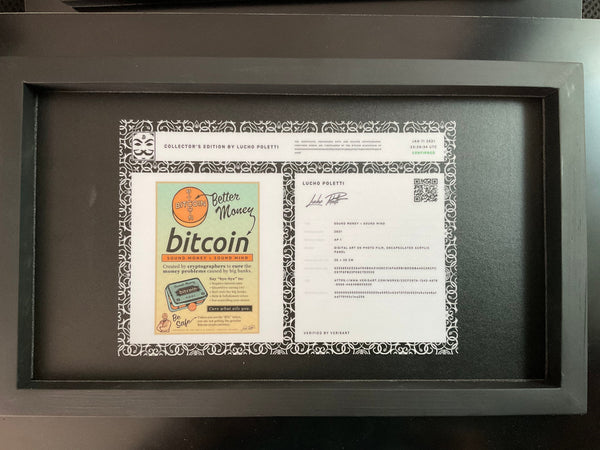
And if you are new here, start with the pieces you can hold today. The collector editions are hand signed, numbered, and backed by a certificate timestamped on Bitcoin. Same message, different medium.
Run before it's too late.

Leave a comment